Hi! I’m Daniel Sagerman. Welcome to my website.
Hi! I’m Daniel Sagerman.
The Ultimate Underdog
Hi! I’m Daniel Sagerman. Welcome to my website.
Hi! I’m Daniel Sagerman.
Going into the 2020 NFL season, six teams introduced new team uniforms, branding, and marketing campaigns that have generated a wide variety of reactions among influencers from the world of professional sports marketing. As an aspiring sports-business professional with a Master’s degree in Sports Administration from Northwestern University as well as several years’ experience working in the sports industry, I have analyzed and ranked these six uniforms in accordance with my own opinions as well as insights gathered from influencers around the sports industry.
(Note: click each photo to enlarge)
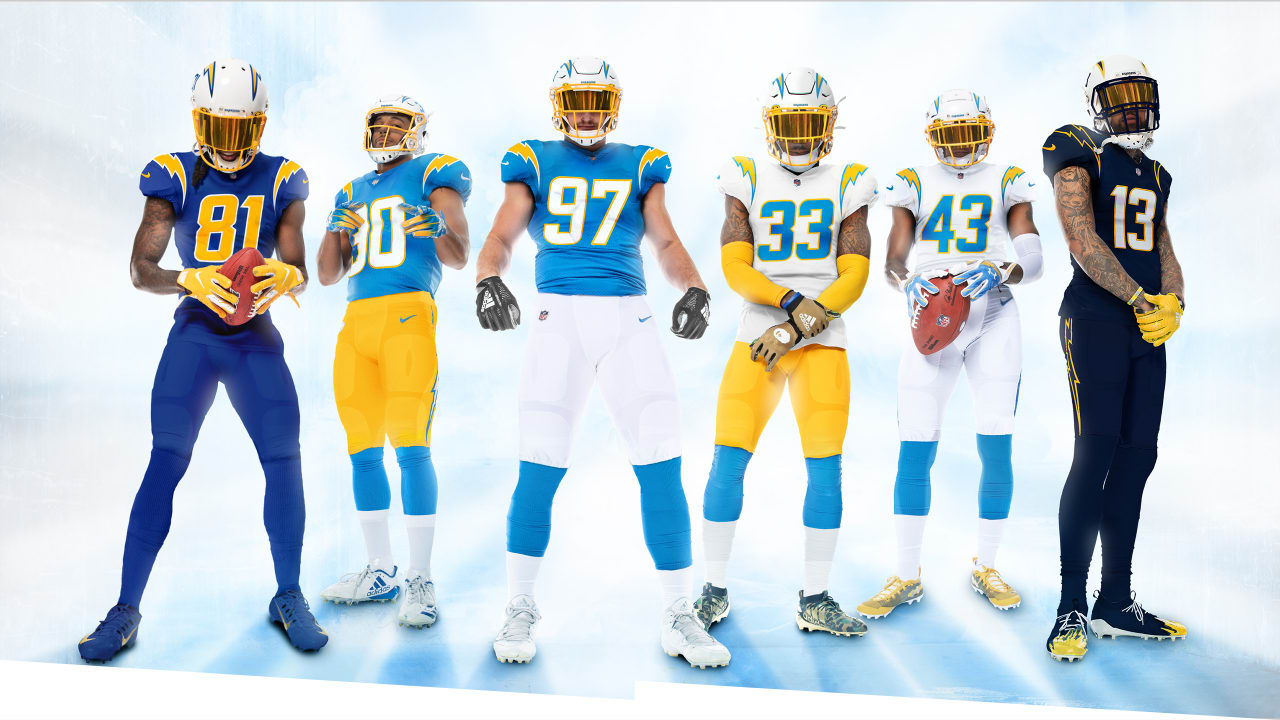
The L.A. Chargers have always had fantastic uniforms that tie in elements that make them unique: prominent lightning bolts and their signature powder blue color. This year, the Chargers went all-in on the powder blue and the results were spectacular. Paul Lukas, creator of the sports aesthetics blog “Uni-Watch” and one of the nation’s leading experts on uniforms in sports, analyzed the Chargers’ uniform unveiling in his April 2020 article “Bolt from the Blue: Chargers Unveil Sharp New Uni Set”. Lukas immensely praised the Chargers’ new threads, calling them “A big win… For their six decades of existence, the Chargers have been through several different uniform eras but have never had a bad uniform set. Not many teams in any sport can say that — well done”.
Lukas also hinted in the article to a possible new uniform trend for all NFL teams based on the fact that the Chargers’ new jerseys didn’t feature “TV numbers”, or, numbers on the shoulders. However, Lukas stated that although both the new uniforms released by the Chargers and the Patriots, which I will review later in this post, did not feature TV numbers, 29 of the league’s 32 teams still featured them – thereby nixing the possibility of a new trend.
Overall, I completely agree with Lukas’ analysis and trust his reputation as one of the nation’s leading sports uniform experts. The Chargers’ design is simple yet awesome – with a unique color scheme and timeless feel. These are hands-down the best new uniforms going into the 2020 NFL season.
2. Cleveland Browns
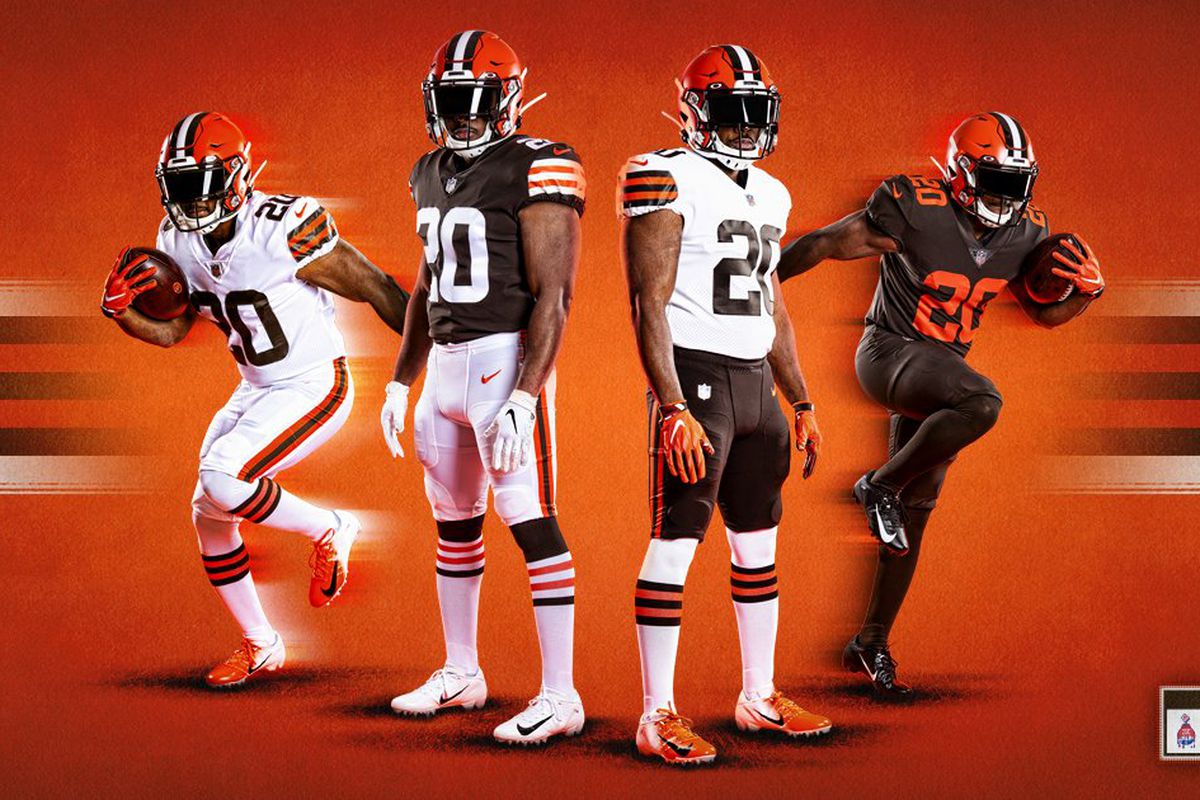
It’s difficult to follow up the beautiful LA Chargers’ uniforms in the rankings, but the Cleveland Browns’ new threads make an easy case for number two. The Browns retreated from (in my opinion, as well as many others’) one of the worst uniform sets in sports back to a timeless look similar to the ones that the team sported from the late 1980’s to 2014.
Connor Orr’s May 2020 Sports Illustrated article “New NFL Uniforms: The Definitive Rankings” also place the Browns’ new set at number two, right behind the Chargers. Orr explains that as a team with a unique color scheme (brown and orange) and rich football history, “reverting to a look that more closely resembles their last run of success in the late 1980s [is] wise. Timeless is always better”.
Additionally, Paul Lukas offered high praise for the Browns’ new uniforms, calling them “a huge upgrade”. Lukas does note, however, that the uniform set would be even better with the addition of orange pants. I completely agree with this, as the orange color can offer an even better contrast with the brown jerseys than white pants, in addition to taking advantage of their unique color scheme.
These uniforms are timeless, clean, and true to the Browns’ brand and history. They are an easy choice for number two.
3. Tampa Bay Buccaneers

The Buccaneers followed the footsteps of the Browns by reverting back to a timeless look of their own. In doing so, the Bucs also ditched their own garish look, complete with “alarm clock” numerals, in favor of a sleeker, simpler design. The Bucs’ new uniforms closely resemble their look from 1997 to 2014, with a few minor tweaks.
The Bucs also introduced a new, all-pewter alternate uniform set, which is a good one, but not on the same level as their primary home and away uniforms. Uniform expert Paul Lukas commented, “it’s obviously way better than what they’ve been wearing for the past six seasons. It looks like a football uniform, not a costume”.
Overall, this is a very solid uniform set. Just like the Browns, the Buccaneers abandoned their atrocious, costume-like “modern” uniforms in favor of a timeless, clean look that never should have went away in the first place.
4. New England Patriots

After the departure of longtime quarterback Tom Brady (who left for Tampa Bay and will be the franchise’s first quarterback to wear their updated uniforms), the New England Patriots thought it would be the perfect time to introduce new uniforms. Well, kind of.
For their new home uniforms, the Patriots took their current “color rush” alternate blue jersey and declared it their new primary home jersey. To complete the look, the Patriots brought in blue pants with red and white stripes down the sides. For the road uniform, the Patriots created a white version of the new blue home jersey to go with the same pants. The team retained their iconic silver helmets.
Overall, the uniform is good but not great. There were several missed opportunities for the Patriots’ uniforms to go from just good to one of the league’s best. First, there should have been white pants to go with the home blue jerseys, creating more contrast and avoiding what Paul Lukas calls the dreaded “leotard effect”.
Additionally, the white jerseys could have been improved if the shoulder stripes were inverted to have blue stripes on the outside. That would have created better contrast and really make the design pop more.
5. Los Angeles Rams
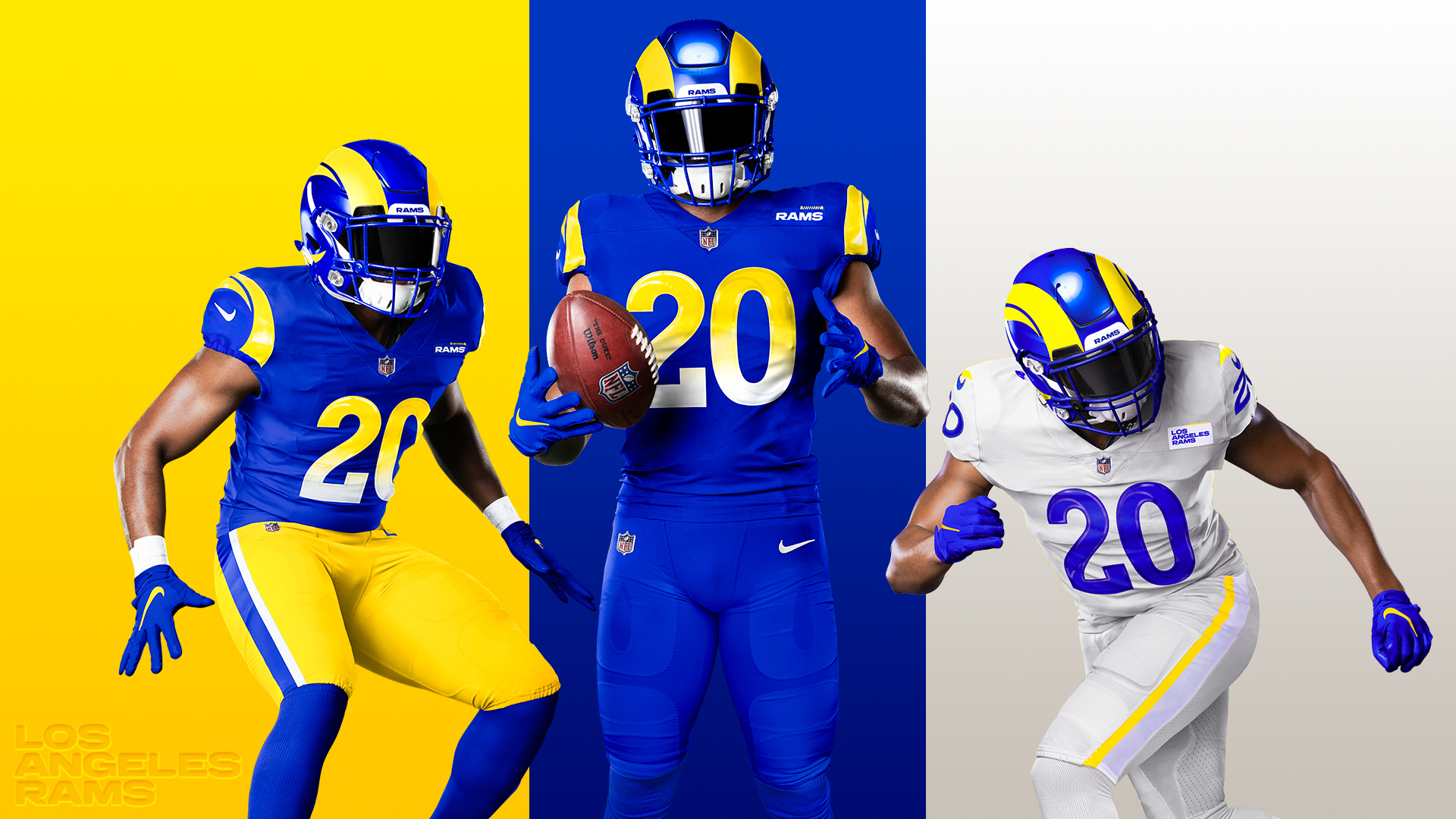
I have no idea what the Rams were thinking here. The Rams moved away from one of the league’s best looks, featuring several timeless uniform elements such as horns around the sleeves and helmets, to go bold with something new.
Man, did it backfire.
As the NFL continues to evolve in the modern world of social media, teams will try to appeal to younger audiences with ‘edgy’ or ‘bold’ new looks. However, new is not always better. Their new uniforms barely resemble what the majority of NFL fans know as the Rams, and their iconic look is no longer there. While some of the uniform elements from previous years make it to the new set, including their iconic blue and yellow color scheme, they are overshadowed by many more poor aesthetics such as gradient numbers.
The Rams had the chance to follow the footsteps of the Brown and Buccaneers by reverting to a classic look, but they chose to go in the complete opposite direction. And it was not a good choice.
6. Atlanta Falcons

How do you make a mediocre uniform set worse? Just ask the Atlanta Falcons.
I have nothing positive to say about the new home and away sets. The oversized “ATL” on the chest is unnecessary and seems out of place. The red text on a black jersey is difficult to read. The numbers are also oversized and while I do appreciate the team’s unique font, they are too big to be aesthetically pleasing. The alternate red-to-black gradient uniform is atrocious.
The one positive, though, is that the Falcons retain their classic “throwback” alternate uniforms, seen on the far right of the graphic. These are simple yet awesome, a timeless and beautiful look, an extremely popular with fans. The Falcons missed a major opportunity to promote their iconic alternates to their primary uniforms and create a corresponding road set, which would have been a huge hit with football fans everywhere.
However, the beautiful throwback alternates were not enough to place the Falcons any higher in the rankings. Just like the Rams, the Falcons ignored a popular iconic look in favor of a forward-thinking, bold new set in an attempt to appeal to younger crowds. In doing so, they downgraded their uniform sets in an extremely detrimental way.
Having now read my own definitive rankings, I encourage you to take the following actions:
In conclusion, ranking uniforms can be a subjective process with no right or wrong answer. However, listening to influencers and experts such as Uni-Watch’s Paul Lukas, we can determine what creates a popular and aesthetically pleasing uniform, in addition to seeing what trends are forming in the sports industry.
Daniel Sagerman is a former Media Relations Intern for the Chicago Dogs Baseball Club in Rosemont, Illinois, and a former Athletic Communications Assistant for the Northwestern University Department of Athletics. Sagerman is a two-time graduate of Northwestern, earning a Bachelor’s in Economics and Business Institutions and a Master’s in Sports Administration. Sagerman aspires to be a sports executive, and Northwestern University Professor Randy Hlavac’s Social Media Marketing Certificate program will play a crucial role in his career path.
As part of my Master’s in Sports Administration curriculum at Northwestern, I studied what makes a successful leader in LEADERS 481. I was exposed to many different leadership styles, but there were a few that resonated with me. In this post, drawn from my final paper for the course, I discuss my personal leadership philosophy and the role LEADERS 481 played in shaping it.
The Approach
Throughout LEADERS 481, I was exposed to many different leadership styles and tactics. Each style of leadership had advantages and disadvantages, and could be applied to a variety of real-world applications. After engaging in discussions with my professor and classmates throughout the course, I realized that I had been practicing aspects of certain leadership styles in my professional career. However, the course also provided me insight into what I must do in order to be the best possible leader. The hallmark of my personal leadership style is “lead by example”, which can be summarized by the combination of authentic leadership and servant leadership.
The first main aspect of my personal leadership style is authentic leadership. Since this is a relatively new style of leadership, it can be difficult to define. Yet, this leadership style is mainly concerned with the authenticity of the leader. In today’s society, “fake news” – whether actually fake or not – dominates headlines. Now more than ever, there is a demand for authenticity and truth – especially from those in leadership positions.
According to Peter Northouse, author of Leadership: Theory and Practice, there are three main ways to define authentic leadership. First, authentic leadership can be defined from an intrapersonal perspective, which focuses on how the leader incorporates their life experiences into their own self-awareness. Next, authentic leadership can be defined as an interpersonal process. This process is highlighted by the relationship between the leader and his/her followers, mainly the transparency of their interactions and how they reciprocate one another. The last way authentic leadership can be defined is from a developmental perspective. In this perspective, authentic leadership is not something someone is born with. Rather, a leader develops authenticity throughout their lifetime by reflecting on major life events and utilizing the takeaways to determine how to become a better leader.
Authentic leadership is important because of the demand for authenticity. This demand is the result of major events, or even catastrophes, that have occurred in our society. For example, recent scandals at huge corporations such as Enron and WorldCom, as well as massive failures in the banking industry, has created an overwhelming sense of uncertainty and pessimism. When people are insecure about the world around them, they seek the steady hand of leadership to guide them. In order to set society back on track, these leaders must be authentic and transparent. Additionally, since this type of leadership is relatively new, there is much demand from researchers to study authentic leadership – mainly, what the parameters are, and how can it be developed. At the end of the day, I find it best if those in leadership positions were honest and insightful, showing their true authentic selves.
The second aspect of my personal leadership philosophy comes from servant leadership. Similar to authentic leadership, servant leadership can also be difficult to define. Harvard Business Review’s Dan Cable summarized servant leadership best: “To put it bluntly, servant-leaders have the humility, courage, and insight to admit that they can benefit from the expertise of others who have less power than them. They actively seek the ideas and unique contributions of the employees that they serve” (Cable). Simply put, servant leadership means to lead by example, leading the team by being a member of it.
Servant leadership is an important feature of fostering a culture of innovation and learning. As they actively seek new ideas and feedback from their employees, servant leaders contribute towards that culture. They invest in human capital, as having the right members in the right positions is crucial for success. Servant leaders place their own interests aside and are willing to serve others. They share the power in decision making – consulting with their teams in finding the best course of action for the organization. This type of leadership is appealing to employees as they truly feel part of a well-functioning team.
Authentic leadership and servant leadership share many of the same values that are critical for establishing an organizational culture of success. Both of these leadership styles rely on establishing strong relationships between leaders and their followers. Strong relationships create trust, bestow confidence, and foster a culture of innovation. Authentic leaders and servant leaders are both disciplined, which allows them to do what’s necessary to achieve their goals. Above all, authentic leaders and servant leaders are humble. They are trustworthy leaders that place the interests of the organization above their own. For each of these reasons, the combined styles of authentic and servant leadership appeals to me. These are the types of leaders I would want to work for in an organization, and therefore they are the types of leaders I aspire to be.
How did I determine that the combination of authentic and servant leadership fit my own philosophy of leadership? Throughout the course, I completed four reflection assignments known as knowledge cards, analyzing a different leadership style each time. A knowledge card consisted of a quote, an analysis of the quote, a personal reflection, and concrete actions to practice the specific leadership type. The knowledge cards allowed for critical thinking about the real-world applications for each leadership type. Two of my knowledge cards were about authentic leadership and servant leadership. As I explored these leadership styles, I realized that they appealed to me. I found powerful quotes for each of these styles, and my personal reflections of them included powerful stories.
The knowledge cards also allowed me to develop a set of concrete actions to demonstrate these leadership styles in real life. For example, to practice authentic leadership I will seek out more feedback from work colleagues, as doing so strengthens the relationship and demonstrates transparency with them. To practice servant leadership, I will continue to participate in community service opportunities such as the Maot Chitim food packing event that I attend every year. Overall, the knowledge cards were an important tool for me to analyze my own leadership style. By critically reflecting on authentic and servant leadership, I realized they were the types of leadership styles I wanted to practice the most.
While I am open to expanding my personal philosophy of leadership beyond the authentic and servant leadership styles, one style I will leave out at this time is crisis leadership. This type of leadership refers to those who lead organizations during times of crisis. Well-known examples include Winston Churchill during World War II and George Bush and Rudy Giuliani during the aftermath of the September 11th attacks. When things are spiraling out of control, these leaders step up and restore that control. They must make quick, yet rational decisions while thinking of the well-being of the organization. I was able to think critically about crisis leadership through one of my knowledge cards and while this style is certainly important, at this time I don’t have the experience necessary to be an effective crisis leader. I can still apply some of the concepts crisis leadership teaches, but at this time I do not have the real-world experience to add this style to my personal philosophy of leadership.
The Benchmark
Another reason the combination of authentic and servant leadership appeals to me is that I am inspired by the leaders that demonstrate these styles. Some of the greatest coaches in the history of sports can attribute their success to their roles as authentic and servant leaders. In my time in this course, I was able to research exactly how these figures applied the leadership styles that were so intriguing to me.
Gregg Popovich, entering his 23rd season as head coach of the NBA’s San Antonio Spurs, is widely regarded as one of the greatest coaches in league history. Since Popovich’s first season in 1996-97, the Spurs have compiled a 1,197-541 record (.689 winning percentage), winning five championships. Amazingly, the Spurs have only had a losing record for 48 days since the 1997-98 season. In addition to consistently being one of the most successful coaches, Popovich is also one of the most authentic.
The hallmark of coach Popovich’s leadership approach is fortifying relationships with his players, a crucial part of authentic leadership. Since the Spurs have players from five different countries, Popovich took the time to learn different languages in order to communicate best with them. He also doesn’t just talk basketball with them – he asks about their families and hobbies. In doing so, Popovich is being true to his authentic self.
In addition to developing relationships with colleagues, authentic leaders bestow confidence in them. The way Gregg Popovich does this was through bonding with his team over meals. Popovich organizes dinners with his team, his coaches, or even a small group of players. He is genuinely interested in learning about different cultures and cuisines, and the players appreciate it. Popovich uses food as a vehicle for making a connection, showing trust, and displaying confidence in his team. Authentic leaders must also find a vehicle to bond with their colleagues to strengthen the relationship between them.
Further, authentic leaders must not only give feedback, but must seek it and incorporate it to themselves as well. One way Popovich does this is by utilizing ‘magical feedback’, a simple message that reinforces the high standards of the organization. At each practice, Popovich meets with each player and explains, “I’m giving you these comments because I have very high expectations and I know that you can reach them” (Coyle). Not one of those words indicate how the player is expected to improve. The feedback delivers a powerful cultural signal that reinforces Popovich’s high standards and expectations for his players. Popovich’s magical feedback reinforces to his players that they are part of a unique group, where the standards are high but attainable.
Speaking different languages, sharing meals, and providing ‘magical feedback’ has allowed Gregg Popovich to create a culture of success in San Antonio. Popovich truly is an authentic person and leader. As Spurs assistant coach Chip Engelland said, “A lot of coaches can yell or be nice, but what Pop does is different. He delivers two things over and over: he’ll tell you the truth, with no BS, and then he’ll love you to death” (Coyle). Popovich’s ability to connect with his team by simply being himself has allowed the Spurs to be one of the NBA’s most successful organizations, and is a true demonstration of authentic leadership.
Servant leadership is equally prevalent in the world of sports. After all, most athletes are part of teams, and must learn to serve their teammates. Similarly, the most successful coaches are those who learn to serve their players. To quote the legendary Michigan football coach Bo Schembechler, “No man is more important than The Team. No coach is more important than The Team. The Team, The Team, The Team, and if we think that way, all of us, everything that you do, you take into consideration what effect does it have on my Team?”
One of the hallmarks of servant leadership is putting others above yourself. This notion is epitomized in Schembechler’s most famous quote. Schembechler unequivocally viewed his Wolverines as a team, plain and simple, and he included himself in it. No one person was more important than another, and they all shared accountability. As the leader of the Wolverines, Schembechler preached that every player should consider how their decisions affect the welfare of the team. The players served one another. Schembechler, too, served his Wolverines by implementing the ‘team first’ culture at Michigan.
Through Schembechler’s steady hand of servant leadership, the Wolverines experienced unprecedented success. In Schembechler’s twenty seasons as head coach, his teams compiled a record of 194–48–5 (.785 win percentage) and won or shared 13 Big Ten Conference titles. Though the Wolverines never won a national championship under Schembechler, they finished ranked in all but one season, and 16 times they placed in the final top ten of both major polls. His leadership was appreciated on a national scale, as he won Big Ten Coach of the Year six times and various National Coach of the Year awards five times.
Gregg Popovich and Bo Schembechler are just two figures that embody my personal philosophy of leadership. They are admirable, both in their personalities and in their acts of leadership. I am a firm believer in establishing strong relationships with my colleagues, building trust and bestowing confidence in them. Popovich does this better than perhaps any NBA coach, and his ‘magical feedback’ cultivates a winning culture in San Antonio. Schembechler’s team-first mentality is critical for success, because organizations cannot accomplish their goals without a strong team. These two coaches take responsibility for their decisions and their communication tactics. They say “we”, rather than “I”. Being a strong communicator, a strong relationship builder, and upholding strong values are all important aspects of authentic and servant leadership, reflecting my personal philosophy of leadership.
The Implementation
As a 23 year-old graduate student, I am not currently in a senior management position to directly lead a group of employees. However, there are still ways that I can implement aspects of my personal leadership philosophy in the smaller everyday roles I do have. There are certain beliefs and concrete actions I must teach in order to take the steps towards becoming a leader that is authentic and serves others.
Northouse describes four key positive psychological attributes that have an impact on authentic leadership. The first attribute is confidence. By believing in my abilities to accomplish my goals, I build confidence in myself. It is equally important to demonstrate confidence in my colleagues by serving them. The second attribute to demonstrate is hope. In other words, believing that the goals I set are difficult, yet achievable through hard work and dedication. The third attribute is to be optimistic. Having favorable expectations about the future and sharing those expectations with others demonstrates a genuine interest in a successful organization. The last attribute is to be resilient, having the capacity to adjust and recover from adverse situations. I must communicate these values to my colleagues, both verbally and through actions. By instilling these four psychological attributes in every professional role I have, I will take the first steps towards becoming the leader I aspire to be.
With the first step in implementing my personal philosophy of leadership being to instill four psychological principles, the next step is to put those values into action. Northouse also describes four action components necessary for authentic leadership, an important part of my leadership philosophy. The first component is self-awareness. By realizing my own values, feelings, and goals, I can be my authentic self. Next, having an internalized moral perspective and balanced processing abilities are essential for authentic leadership. In other words, I must keep my morals in mind while interpreting and processing information before making rational decisions. Finally, relational transparency, or the the ability to communicate in an open and honest manner with others, is fundamental for authentic leadership. I must utilize these four components in every professional role I have in order to begin implementing my personal leadership philosophy.
There are also smaller-scale and more concrete actions I can perform to instill my personal leadership philosophy onto others. One crucial way to demonstrate my leadership abilities is through community service opportunities. Almost every year, my family and I volunteer for the Maot Chitim food packing event, creating food boxes to deliver to needy Jewish families in the Chicagoland area around the Jewish High Holy Days. Working with Maot Chitim is inspiring, and I truly feel part of a team that serves each other, where we all demonstrate servant leadership. I will not only continue to volunteer at this event, but also encourage my friends from my Master’s program at Northwestern to participate in their own service opportunities. Furthermore, I will serve as a mentor my younger brother, a junior in college, in navigating the post-college work lifestyle. By offering him advice that incorporates the principles of my personal leadership philosophy, I am taking steps towards becoming an authentic, servant leader.
I will also seek out more feedback from work colleagues. Doing so strengthens the relationship in addition to demonstrating transparency. After all, Gregg Popovich’s ability to seek out and incorporate feedback for his players turned him into one of the greatest coaches in NBA history. Additionally, I will strive to offer more praise to my friends, family, and co-workers. Doing so demonstrates confidence and shows authenticity, two crucial aspects of my leadership philosophy.
It will take time to implement all the steps I discussed before I become the authentic, servant leader I yearn to be. Some aspects will have more specific time constraints than others. First, developing Northouse’s psychological attributes and action components through real-world experiences will take time. This will likely take place over two to three years, while I become exposed to various types of leaders in an entry-level position. The more experiences I have, the more I will be able to build my confidence, hope, optimism, and resilience. Utilizing those values and becoming truly self-aware will take some time as well.
The smaller-scale, more concrete actions will obviously take significantly less time. Volunteering at food packing events, soup kitchens, or other community service events are relatively easy to make time for, and are not time-consuming. Therefore, it’s important to not neglect these responsibilities, as they are crucial for developing the mindset of an authentic, servant leader. Mentoring my younger brother can be time-consuming in some aspects, but overall is more of a continuous process. Doing the small things, such as seeking out and providing feedback, offering encouragement, or simply having a casual conversation with a co-worker, takes little to no time at all. Although these actions are simple and not time-consuming, they are still significant to the development of my personal philosophy of leadership.
At the same time, it’s important to keep in mind that leadership is a lifelong process. No one is born a leader – leadership must be crafted over time, taking every major life event into account. Leadership requires action, not just using your traits. While some aspects of my leadership philosophy are simple and not time-consuming, the only way I will become the leader I strive to be is through taking my life experiences and analyzing them. By analyzing major life events, such as job promotions, moving, or even changing careers, I will become more self-aware of what appeals to me as a leader. It is possible that I will continue developing my personal leadership philosophy for ten years or more. Overall, I am looking forward to the journey my professional career will take me – eventually transforming me into an authentic leader that serves others well.
The Challenges
There are some potential drawbacks to both the authentic and servant leadership styles. First, they are both relatively new styles of leadership, so they are not thoroughly researched or tested methods. Authentic leadership can be difficult to define, as authenticity can be subjective. For example, one person’s sense of ‘authenticity’ will be different from everyone else’s, and may or may not be at the level necessary for successful leadership. Furthermore, there is no clear link between authentic practices and organizational success. Just because a leader is authentic doesn’t mean the employees will follow, or any organizational change will be made. Furthermore, as discussed in the previous section, both authentic and servant leadership can be time-consuming with unclear timetables.
Authenticity isn’t everything, and it must be combined with the proper values, mindsets, and goals in order to be successful. As Lisa Rosh and Lynn Offermann discuss in their Harvard Business Review article “Be Yourself – But Carefully”, authenticity can be a double-edged sword. Despite its obvious benefits, self-disclosure can “backfire if it’s hastily conceived, poorly timed, or inconsistent with cultural or organizational norms—hurting your reputation, alienating employees, fostering distrust, and hindering teamwork” (Rosh & Offermann). Being authentic can be tricky, even for the most experienced leaders.
People can be authentic about who they are, but that alone won’t be enough for success. Authentic leadership is about combining the self-awareness with establishing relationships with employees and developing them. Self-awareness also requires self-discipline. For instance, if you consider yourself an ‘open book’, learning to not share every little detail about yourself is crucial, because doing so could be harmful to the organization.
Similarly, servant leaders must not rely solely on their service to others to be a successful leader. A potential weakness of servant leadership is that the leader spends so much time being part of a team that he or she forgets to lead it. Lacking self-awareness is detrimental to the learning process. It’s important for the servant leader to share accountability with their team, but they are ultimately figures of authority. Take that away, and the servant leadership model could prove problematic.
Reflection
I concluded LEADERS 481 having learned about numerous types of leadership styles. Each style was interesting to learn about, had advantages and disadvantages, and had the potential to be useful in a wide array of organizational processes. However, I knew that the two that appealed to me the most were authentic leadership and servant leadership. As a result, it was not difficult to develop my personal philosophy of leadership.
This paper was useful for establishing the guidelines necessary for me to become the leader I aspire to be. Authenticity and servitude are two attributes that I value immensely, and will emphasize them in whatever leadership position I find myself in. I will follow in the footsteps of Gregg Popovich and Bo Schembechler, two of the most respected and admirable leaders in their respective fields, by establishing strong relationships with my colleagues and creating strong teams. I will begin developing Northouse’s psychological attributes to leadership and put them into action. I will continue to serve my community, and encourage others to serve as well. Above all, I will “lead by example”. By adhering to my personal philosophy of leadership, I know I will grow into a genuine, respected leader.
References
Bhatia, S. (2017, May 12). Five Ways To Demonstrate Leadership In Times of Crisis. Retrieved
August 20, 2018, from Forbes
Cable, D. (2018, April 23). How Humble Leadership Really Works. Retrieved August 20, 2018,
from Harvard Business Review
Coyle, D. (2018, January 31). How Gregg Popovich Uses ‘Magical Feedback’ to Inspire the San
Antonio Spurs. Retrieved August 22, 2018, from Time
Drucker, P. F. (n.d.). What Makes an Effective Executive. Harvard Business Review.
Northouse, P. (2016). Leadership: Theory and Practice (Seventh ed.). Los Angeles: SAGE
Publications.
Rosh, L., & Offermann, L. (2013, October). Be Yourself – But Carefully. Retrieved August 24,
2018, from Harvard Business Review
Happy to have you here!
Explore the tabs above to learn more about me and what makes me special.


 Daniel Sagerman